

Each year, more than 1.5 million wildebeest, joined by vast herds of zebra and gazelle, follow the rains through Kenya and Tanzania in their never-ending quest for food. Over the course of the journey, they may cover close to 1,000 miles, making the Great Migration one of the largest movements of land mammals on Earth.
It is difficult to understand the scale until you are standing in front of it. You often hear the herds before you see them: the thunder of hooves, low grunts carrying across the plains and dust rising above the grass. Then thousands of wildebeest come into view, stretching toward the horizon, with zebra threaded through their ranks.
The herds move continuously through the Serengeti–Mara ecosystem, but what you witness changes considerably throughout the year. Depending on the season, the experience may center on calving, large concentrations of animals, predator activity or the possibility of a river crossing. Where you travel—and when—determines which stage of the migration you are most likely to see.
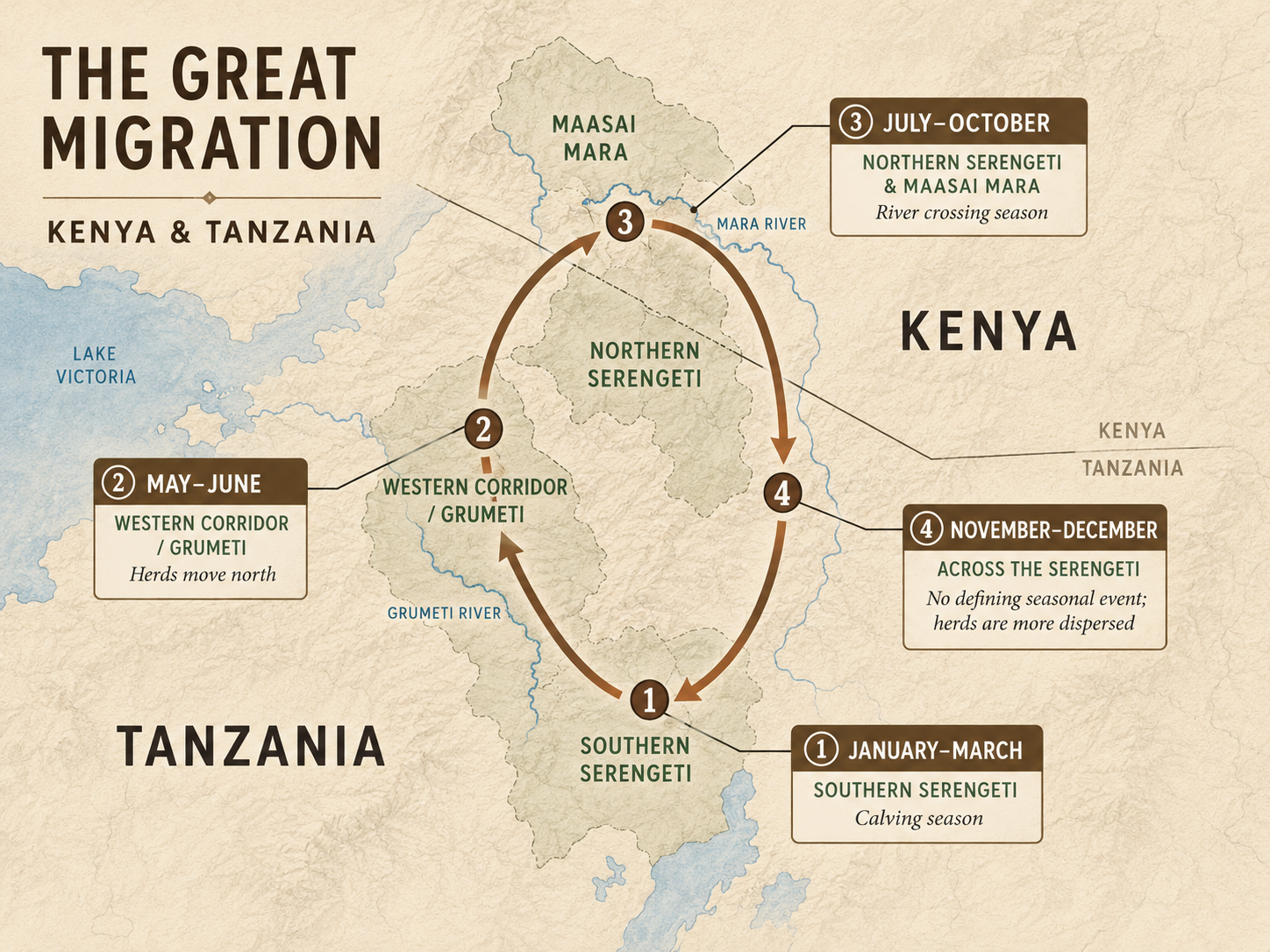
1. Map of the Great Migration
2. When is the Best Time to See the Great Migration?
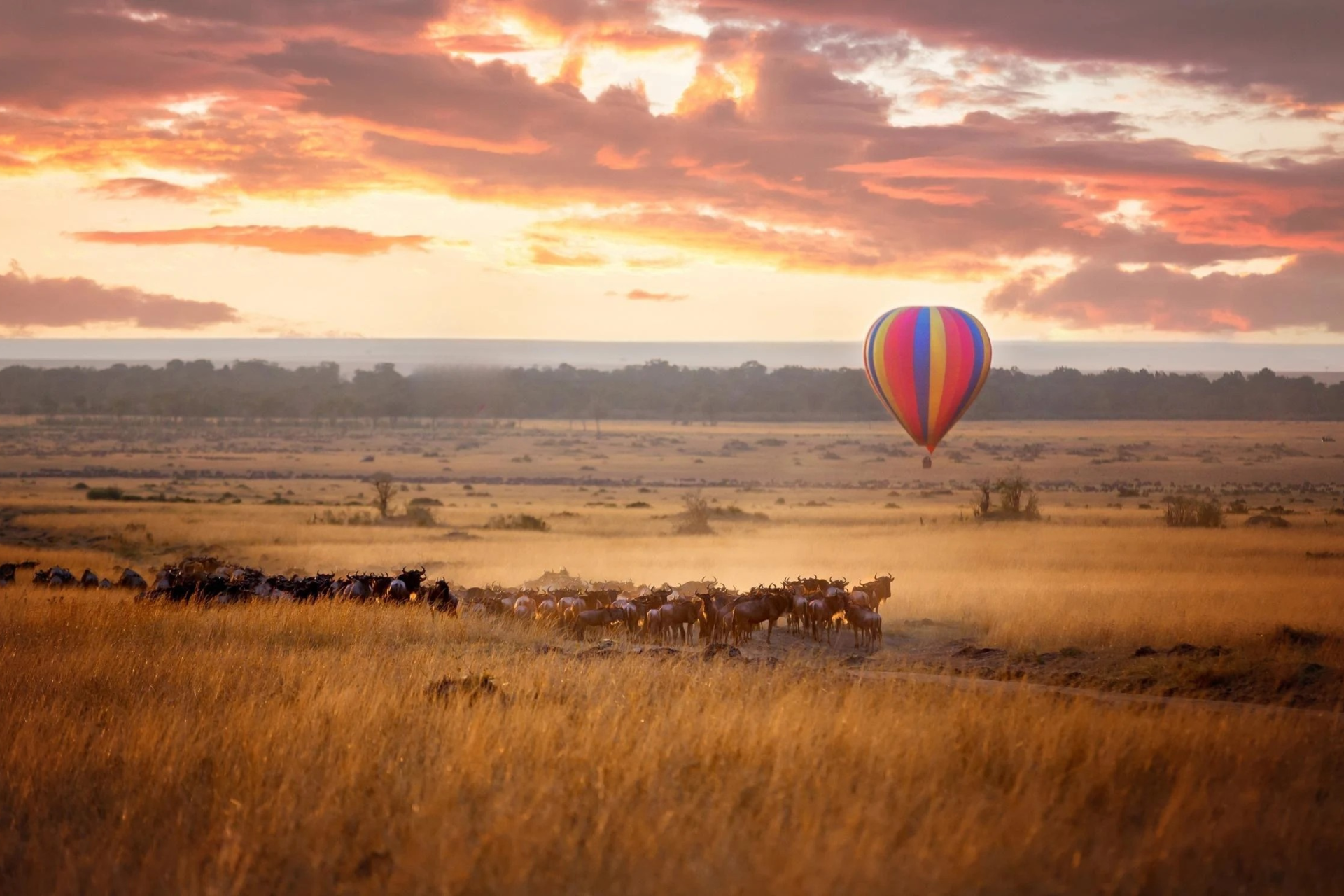 THE IDEAL TIME: JULY TO OCTOBER
From July through October, the herds reach the northern Serengeti and Kenya’s Maasai Mara. Vast numbers then gather along the Mara River, where the crossings most closely associated with the Great Migration take place.
Hours can pass before the first animal enters the water. Those nearest to the edge inch forward, then recoil into the mass, visibly unsettled by what lies ahead. That unease stems from the very real dangers below: Nile crocodiles may be waiting beneath the surface, while the force of the river and its steep banks pose risks of their own. As the herd thickens along the shoreline, those at the front are pressed ever closer to the water. Guides switch off their engines and remain still, watching for the moment the hesitation breaks.
Then, often without warning, one wildebeest runs down the slope and plunges into the river. Those behind follow almost immediately, and within moments, thousands are surging toward the water. The hillside erupts beneath pounding hooves as they launch into the fast-moving current, many becoming briefly submerged before resurfacing amid the tightly packed mass. Calves struggle to remain beside their mothers as predators move below. On the opposite side, those that make it across scramble up the churned mud, slipping backward as thousands continue to follow.
The transformation is immediate: one moment of tense stillness, followed by a wall of sound, dust and movement. The timing of an individual crossing can never be guaranteed. The animals may turn away after reaching the bank, remain there for hours or cross several times in a single day.
July through October is also the busiest period. Camps book far in advance, and the most accessible crossing points can attract large numbers of vehicles. The right camp, an exceptional guide and enough time in the region can make a profound difference to the experience.
WHEN TO AVOID THE CROWDS
Travelers who value privacy, fewer vehicles and a quieter experience can consider other stages of the migration.
JANUARY TO MARCH: CALVING SEASON
From January through March, the herds gather across the short-grass plains of the southern Serengeti, where roughly half a million wildebeest calves may be born within a matter of weeks.
Newborns struggle to their feet almost immediately, taking their first uncertain steps while lions, cheetahs and hyenas watch from the edges of the herd. The concentration of young animals draws significant predator activity, while the openness of the plains offers wide-ranging views of these encounters as they unfold across the landscape.
MAY TO JULY: THE HERDS MOVE NORTH
As the southern plains begin to dry, the migration moves through the central Serengeti toward the Western Corridor and Grumeti. The exact route and timing depend on rainfall, but, as Singita notes, guests staying at Grumeti can typically witness the migration between May and July. Seeing the herds generally means heading out on game drives across the reserve rather than watching the migration from the properties themselves. At over twice the size of New York City, this private 350,000-acre concession has just seven properties spread across its immense landscape.
Most travelers associate the Great Migration with the river crossings from July through October. Far fewer know that guests staying at Grumeti have the opportunity to see the migration earlier in the year, when the experience unfolds across a vast private concession with far more space and far fewer vehicles than during the peak crossing season.
Our knowledge of this window comes from having scouted Faru Faru, Sasakwa and Sabora firsthand. Every property we recommend to our travelers is one we have experienced ourselves, giving us a clear understanding of when each is at its most compelling, how the herds move through the surrounding landscape and which lodge offers the right balance of wildlife access, privacy and service for a particular traveler.
Grumeti itself has undergone an extraordinary transformation. When conservation work began in 2003, nearly all of the wildlife had been hunted out. Two decades later, lions, leopards, cheetahs, elephants, giraffe, hyena, buffalo, wildebeest, and other species dominate the landscape in remarkable numbers, and the reserve is a critical part of the migration route.
NOVEMBER TO DECEMBER
November and December are generally less compelling months for a trip focused specifically on the Great Migration, as there is no defining seasonal event and the herds can be more difficult to locate. Travelers hoping to avoid peak-season crowds will usually find January through March or May through June more rewarding.
3. Serengeti or Maasai Mara: Which is Better for the Great Migration?

WHY CHOOSE TANZANIA AND THE SERENGETI?
The Serengeti offers a sense of scale that is difficult to match anywhere else in Africa. During the migration, the plains can appear to move as entire horizons fill with wildebeest and zebra. Even after the main herds move on, the ecosystem remains exceptionally rewarding.
The numbers are almost difficult to comprehend. The Serengeti supports roughly 4,000 lions, 1,000 leopards, 225 cheetahs and 3,500 spotted hyenas, alongside some 70,000 buffalo and 2,700 elephants. This concentration of resident wildlife means that sightings often follow one another: a lion pride resting on a kopje, cheetahs hunting across the open grasslands, elephants moving through a river valley or hyenas gathering around a kill.
The landscape changes just as dramatically. The southern plains are vast and exposed; granite outcrops rise like islands above the grass; acacia woodland gives way to river systems and the more rugged hills of the north. Each shift changes the safari, from uninterrupted views across open country to quieter searches through forest and rocky ground.
For travelers with more time, the Serengeti can be paired with the Ngorongoro Crater, the world’s largest volcanic caldera, measuring roughly 12 miles across and enclosed by walls rising around 2,000 feet. More than 25,000 large animals live within its grasslands, forests and lakes, including lions, hyenas, elephants, black rhinos, wildebeest and zebra. The crater floor holds the highest density of predators in Africa, while flamingos gather on its lakes, adding flashes of pink to the landscape.
Together, the Serengeti and Ngorongoro create a far richer journey through Tanzania than an itinerary built around the river crossings alone. Click here to explore the Crater in greater depth.
WHY CHOOSE KENYA AND THE MAASAI MARA?
The Maasai Mara concentrates river crossings, predator activity and frequent wildlife sightings within a relatively compact landscape. Guides can move quickly between the Mara River and other parts of the reserve, giving the safari a faster, more immediate rhythm than the vast expanses of the Serengeti. That pace makes it particularly well suited to travelers with less time, who can experience much of what the region has to offer within a shorter stay.
Beyond the national reserve, the surrounding community conservancies protect a significant share of the area’s large-animal population. More than 83% of the animals recorded in a 2021 aerial census were found within these protected areas. Naboisho alone has more than 70 identified lions and one of the highest lion densities in the world. Visitor numbers are carefully controlled, making it possible to remain at a sighting without being surrounded by a ring of vehicles.
Some of our favorite home bases for seeing the herds here are Great Plains’ Mara Plains, Mara Nyika and Mara Toto. Their locations offer excellent access to the wider ecosystem and the areas where the animals are most likely to be found, but the migration should not be expected to pass directly in front of the property.
From here, the journey can continue north to Laikipia, where travelers can track black and white rhinos on foot with trained rangers, ride horses across private conservancies and sleep beneath the stars with Mount Kenya on the horizon.
Farther north, the green plains give way to Samburu’s red earth, rocky hills and palm-lined rivers. Grevy’s zebra, reticulated giraffes, Beisa oryx, Somali ostriches and gerenuk—long-necked antelope that stand upright—make this part of the country feel like an entirely different safari.
For travelers with enough time, northern Tanzania and southern Kenya can be combined in a single journey, revealing two distinct expressions of the same ecosystem.
4. Why Plan the Great Migration with The Legacy Untold?
 The Legacy Untold’s founder, Mark Lakin, has been honored as one of the world’s most trusted travel advisors by Travel + Leisure, Oprah Daily and Robb Report. Across more than 70 journeys to Africa, Mark has developed an intimate understanding of the migration and how best to experience it.
His connection to the migration is also personal. During the COVID-19 pandemic in 2020, Mark moved to Tanzania and lived at Singita Grumeti.
One afternoon, he stayed on-property to work from his suite. Several hours into conference calls, his tent began to shake and the floor beneath his feet started to rumble. When he looked outside, thousands of wildebeest were crossing the river directly in front of the property.
He climbed into his private swimming pool and watched as they kept coming and coming across the landscape. It remains one of the most extraordinary moments of his travel career. Click here to watch Mark’s great migration encounter on Instagram.
Experiences like this cannot be arranged on demand, but more than 70 journeys to Africa have taught Mark where to go, how long to stay and which properties and guides offer the strongest chance of being close to the action.
The migration may bring travelers to East Africa, but it need not define the entire journey. In Kenya, Maasai guides and naturalists can explain how tribal pastoralist communities have lived alongside wildlife for generations. In northern Tanzania, time with the Hadza offers insight into one of the continent’s few remaining hunter-gatherer cultures, where tracking, foraging and an intimate knowledge of the land remain part of daily life.
These experiences place the migration within a much larger story—one shaped not only by wildlife, but by the communities, traditions and landscapes of East Africa.
To begin planning a private Great Migration safari, visit www.thelegacyuntold.com or contact [email protected].